A long piece of wood is 8.25 feet long. If this piece were to be cut into 5 equal pieces how long will each piece be?
a. 11.25 inches
b. 19.80 inches
c. 22.75 inches
d. 27.15 inches
Answer : 19.80 inches (answer b)
The student must notice that the dimension of the original piece of wood is in feet units while the answers are in inch units. This is an important observation since all units must match in order to solve the problem. Therefore, as a starting point, we will convert the 8.25 feet into inches. In order to do that, the student must realize that each 1 foot = 12 inches. Therefore:
8.25 feet x [12 inch/1 foot] = 99 inches
(note here that the units for feet are eliminated and we are left with only the inch units we need to continue solving the problem).
Since we need to cut this piece into 5 equal pieces then we must divide the 99 inches by 5 to reach the final answer:
99 inches / 5 = 19.8 inches
©Copyright 2008.Najwa S. Hirn. All rights reserved.
Friday, February 29, 2008

Monday, February 18, 2008
Subtraction - Elementary School Math
There are a total of 72 cars parked in the used parking lot 8 of them are blue. How many cars are not blue?
a. 58
b. 62
c. 64
d. 68
Answer: 64 (c )
This is a subtraction problem. The student must subtract the 8 blue cars from the total 72 cars in order to come up with what is remaining. The remaining number will be the number of cars that are not blue. Here is the step:
72 - 8 = 64
For additional interactive practice visit: Aplusmath.com
©Copyright 2008.Najwa S. Hirn. All rights reserved.
Thursday, February 14, 2008
Functions - College Level Math
If
f(x) = (x-3)
and
g(x) = (2x + 4)
Evaluate:
(f + g) (2)
Answer : 7
The above two equations are examples of the use of the Algebra of functions.
A function is a relation that does not repeat any first coordinates.
The problem is asking the student to evaluate (f+g)(2). This is the same as saying take the sum of functions f(2) and g(2) respectively and evaluate the result.
The steps involved in solving this problem are as follows:

f(x) = (x-3)

and

g(x) = (2x + 4)
Evaluate:

(f + g) (2)
Answer : 7
The above two equations are examples of the use of the Algebra of functions.
A function is a relation that does not repeat any first coordinates.
The problem is asking the student to evaluate (f+g)(2). This is the same as saying take the sum of functions f(2) and g(2) respectively and evaluate the result.
The steps involved in solving this problem are as follows:
- Substitute the equation of f(x) for the (f) value of the function.
- Substitute the equation of g(x) for the (g) value of the function.
- Add the two equations.
- Take the function with respect to (2) Evaluate the answer.
Here is the algebraic solution for the problem.
f(2) = ( 2 - 3) = -1

g(2) = ( 2(2) + 4 ) = ( 4 + 4 ) = 8
(f + g) (2) = ( -1 + 8 ) = 7
© Copyright 2008.Najwa S. Hirn. All rights reserved.
Friday, February 8, 2008
Parallel Lines - High School Math
The line shown on the Cartesian coordinate graph below passes by points AB. Another line needs to be drawn parallel to line AB and passes by point C shown on the graph and point D.


Let apply the formula to find the slope for line AB:
m = (0 - 4)/(1 – 6) = (- 4)/(- 5) = 4/5
An examination of point C on the graph reveals that the coordinates for this point are:
(- 4 , 3).
The student must now use this point and check each of the above coordinates provided as a possible answer to determine which pair resulted in a slope of 4/5.
Once the coordinate pair of (-9 , -1) is checked, it reveals the following:
m = (- 1 – 3)/ (- 9 – [- 4])
m = (- 1 – 3)/ (- 9 + 4) = (- 4)/(- 5) = 4/5
©Copyright 2008.Najwa S. Hirn. All rights reserved.


What coordinates should point D have that will make line CD parallel to line AB?
a. (-3, 4)
b. (-5, 2)
c. (-6, 0)
d. (-9,-1)
Answer: The coordinates for point D are (-9,-1).
In order to solve this problem the student must recall that parallel lines have the same slope. Therefore, the slope that is calculated for line AB will be the same slope for the line parallel to it that passes through point C.
Therefore, step one is to calculate the slope for line AB.
The coordinates for point A are (6,1)
The coordinates for point B are (1,0)
The slope formula states that:

Let apply the formula to find the slope for line AB:
m = (0 - 4)/(1 – 6) = (- 4)/(- 5) = 4/5
An examination of point C on the graph reveals that the coordinates for this point are:
(- 4 , 3).
The student must now use this point and check each of the above coordinates provided as a possible answer to determine which pair resulted in a slope of 4/5.
Once the coordinate pair of (-9 , -1) is checked, it reveals the following:
m = (- 1 – 3)/ (- 9 – [- 4])
m = (- 1 – 3)/ (- 9 + 4) = (- 4)/(- 5) = 4/5
©Copyright 2008.Najwa S. Hirn. All rights reserved.
Monday, February 4, 2008
Finding Angles of a Triangle - Middle School Math
In the following triangle, if angle ABC equals 80 degrees and angle BAC equals 40 degrees, what does angle ACB equal to?

Angle ACB equals 60 degrees.
The measures of the three interior angles of a triangle must equal to a total of 180 degrees. Therefore we must add the two shown angles and subtract that number from 180 in order to find the correct answer. The step is as follows:
180 - (80 + 40) = 60

Answer:
Angle ACB equals 60 degrees.
The measures of the three interior angles of a triangle must equal to a total of 180 degrees. Therefore we must add the two shown angles and subtract that number from 180 in order to find the correct answer. The step is as follows:
180 - (80 + 40) = 60
©Copyright 2008.Najwa S. Hirn. All rights reserved.
Tuesday, January 29, 2008
Data Analysis - Elementary School Math
A shirt manufacturing company manufactures three colored shirts. The circle graph below shows the percentages of each color that is produced. Based on the graph, what percent of blue shirts are produced?
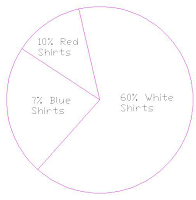
Answer:
30% Blue Shirts
In order to solve this problem, the student must add the total percent of red shirts and white shirts produced and subtract that from 100%. The answer will give the total percent of blue shirts produced. The steps are as follows:
60 % white shirts + 10% red shirts = 70 % shirts out of the total
100 % total shirts – 70 % shirts produced = 30 % blue shirts that are produced.
© Copyright 2008.Najwa S. Hirn. All rights reserved
Thursday, January 24, 2008
Equation of a Circle - College Level
Find the center and radius of the circle that is determined by the following equation:

Answer :
Center = (4,-3)
Radius = 6

The solution is shown step by step below. A detailed description of the solution is provided below the equations.

The problem requires that you find the values for (h , k) and the radius. In order to do that you must first solve for x and y to be able to find the radius points.
You start the problem by making sure that the similar variables are grouped together as follows:
It is noted here that in order to move the number 11 to the other side of the equation, we must first add 11 to both sides of the equation.
You must rework the problem to bring it to the standard form of the equation of the circle. Which is:

In order to do that we must complete the square inside each bracket to find the missing values. We must complete the square for x and for y in order to come up with two quadratic equations that we can factor.
We’ll start with x :
The way to complete the square is by taking half the middle value (number) of the quadratic equation, squaring it and adding it to both sides of the equation.
In this case, the middle value is 8 so we take half of 8, which is 4, and square it so we get 16. This number (16) is added to both sides of the equation as follows:
Now we have two quadratic equations that can be factored. Once they are factored we end up with the following equation:

At this point, it is feasible to solve for x and y by setting each factor to 0 and solving for the variable we come up with:
X = 4
Y = -3
Once we have solved for x and y, it means we found our h and k values which in this case comes out to be (-3,-4).
We still need to find the radius. Since we added a 9 and a 16 to the 11 on the right side of the equation that means we added a total of 36 to the right side of the equation. This 36 is the square of the radius.
If we take the square root of 36 we come up with 6, which is our radius.
Now we have solved the equation and are results are:
(4 , -3) , 6
© Copyright 2008.Najwa S. Hirn. All rights reserved.

Answer :
Center = (4,-3)
Radius = 6

The solution is shown step by step below. A detailed description of the solution is provided below the equations.

The problem requires that you find the values for (h , k) and the radius. In order to do that you must first solve for x and y to be able to find the radius points.
You start the problem by making sure that the similar variables are grouped together as follows:

It is noted here that in order to move the number 11 to the other side of the equation, we must first add 11 to both sides of the equation.
You must rework the problem to bring it to the standard form of the equation of the circle. Which is:
In order to do that we must complete the square inside each bracket to find the missing values. We must complete the square for x and for y in order to come up with two quadratic equations that we can factor.
We’ll start with x :
The way to complete the square is by taking half the middle value (number) of the quadratic equation, squaring it and adding it to both sides of the equation.
In this case, the middle value is 8 so we take half of 8, which is 4, and square it so we get 16. This number (16) is added to both sides of the equation as follows:

Now we do y:
The way to complete the square is by taking half the middle value (number) of the quadratic equation, squaring it and adding it to both sides of the equation.
The way to complete the square is by taking half the middle value (number) of the quadratic equation, squaring it and adding it to both sides of the equation.
In this case, the middle value is 6 so we take half of 6, which is 3, and square it so we get 9. This number (9) is added to both sides of the equation. The resulting equation looks like this:


Now we have two quadratic equations that can be factored. Once they are factored we end up with the following equation:

At this point, it is feasible to solve for x and y by setting each factor to 0 and solving for the variable we come up with:
X = 4
Y = -3
Once we have solved for x and y, it means we found our h and k values which in this case comes out to be (-3,-4).
We still need to find the radius. Since we added a 9 and a 16 to the 11 on the right side of the equation that means we added a total of 36 to the right side of the equation. This 36 is the square of the radius.
If we take the square root of 36 we come up with 6, which is our radius.
Now we have solved the equation and are results are:
(4 , -3) , 6
© Copyright 2008.Najwa S. Hirn. All rights reserved.
Subscribe to:
Posts (Atom)